
We respect your privacy.

4 Myths that Muddle Life

Blog.4+Myths+that+Muddle+Life.jpg

“Oh, that’s not true. It is just a myth!” How often has this declaration kept us from believing an otherwise attractive option?

Myths swirl around us like rumors. Yet, when we allow a myth to lure us into believing it is true, we bring harm to ourselves and those in our sphere of influence. A myth is a fallacy, an error, a misconception, a mistake. In contrast, God’s “…word is eternal, it stands firm in the heavens” (Psalm 119:89).

Here are 4 alluring—even addicting—myths, and God’s Truth to counter:

  1. Balance is a myth.

    Balance in life presents itself as a desirable goal. However, if we are not careful, balance (defined as a situation in which different elements are equal ...) can serve as a taskmaster and drive us to pursue the unachievable. Life is an ebb and flow like the tide, and seasons of the surge are generally followed by seasons of reprieve. Such awareness allows us to contribute to the reality at hand and realize that the gush and rush will give way to recede and regroup. A mother with a sick child, an editor with a deadline, a hostess with a house full of guests, or a student with a project due all have to push; balance is nowhere to be found. Right? But once the guests leave or when the paper is submitted, there is, then, time to reestablish equilibrium.

    Truth: “As long as the earth remains, there will be planting and harvest, cold and heat, summer and winter, day and night” (Genesis 8:22).

    “But seek first his kingdom and his righteousness, and all these things will be given to you as well” (Matthew 6:33).

  2. Control is a myth.

    In the words of my friend Dr. Bill Lawrence, “Control is a myth.” Think about this: Control belongs only to God. In an attempt to control our spouse, our roommate, our circumstances, our future, we harm ourselves and damage relationships. The release of realities and relationships into the Hands of God brings rest, deep soul rest.

    Truth: “Be still and know (recognize, understand) that I am God” (Psalm 46:10 AMP).

    “Do you know how God controls the clouds and makes his lightning flash” (Job 37:15)?

    “Our God is in heaven. He does whatever pleases Him” (Psalm 115:3).

  3. More is a myth.

    “More is not better, it is just more.” This line from a long-ago movie stuck with me. And, in a recent conversation with my adult daughter, I found myself going even further to say, “Sweetheart, less is enough.” When driven beyond reason to accomplish more, create more, acquire more, or do more we are robbed of the pure and simple joy of enough.

    Truth: “But godliness with contentment is great gain” (1 Timothy 6:6).

  4. Normal is a myth.

    Like balance, control, and more, normal is also a myth. In adopting the mindset of: “When this crisis is over, we will be able to get back to normal,” we set ourselves up for a lifestyle of instability and make our peace contingent on our circumstances.

    Truth: “My soul rests in God alone.; my salvation comes from him” (Psalm 62:1).

    “Though the fig tree does not bud and there are no grapes on the vines, though the olive crop fails and the fields produce no food, though there are no sheep in the pen and no cattle in the stalls, yet I will rejoice in the LORD, I will be joyful in God my Savior” (Habakkuk 3:17-18).

    Myths are sinking sand; God’s Word firmly stands.

Living With Eternal Intentionality®

Which myth particularly threatens to lure you away from God and His truth?

What is another myth that you think we easily buy into?

Please add your thoughts to the discussion.

Eric Liddell Just Kept Running

Blog.EricParliment.JPG

As we approach the anniversary of his death, February 21, 1945, the life of Eric Liddell comes into focus.

London: The warm sunny English morning smiled down, and we made our way into the stately building across from Parliament. As delegates with Athletes in Action to the 2012 Olympics, Larry and I felt caught up in the euphoria of the global event. However, today’s gathering was not a sports competition, but rather The Legacy Breakfast for Olympians.

Blog.EricInside.JPG

By the time the event concluded, I found myself with a handful of memorabilia, a collection of pens, and a souvenir teapot. But the greatest treasure was a conversation with two special ladies, the daughters of Eric Liddell. Attending as guests of honor, Patricia and Heather made the story of Scotland’s finest athlete, their father, come alive in an unforgettable way.

Blog.EricPatricia.JPG

Following a lovely meal and formal program, the four of us spoke privately, and these women opened up to share in a warm and personal manner about the man they loved dearly. As if wanting us to know him, too, one sibling declared, “Even on Sunday he organized games for the children in the World War II prison camp.” Her words stayed with me and created a longing to know more about Eric Liddell—not just as an athlete—but as a missionary.

Blog.EricCoverIMG_4739.jpg

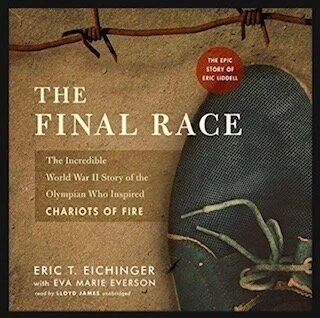
That Olympic–morning–longing recently found satisfaction as I read the book, The Final Race, by Eric T. Eichinger and Eva Marie Everson. Eichinger and Everson take the reader on the other side of the world to run with Eric as husband, father, colleague, and prisoner of war. Indeed, this man—with his whose whole being dedicated to God, his family, and China—consistently lived out his bedrock conviction:

“Surrender means the end of the great rebellion of our wills.”

Thanks to this author duo, we possess a collection of gems in the testimonies of those who spoke of Eric after God called him Home.

Fellow missionary colleague Annie said, “One could hardly argue with his unique skill set and his methods (in ministry) … were never complicated, but simple, clear and direct like his own character. … He was an evangelist to the villages. He didn’t stay put. He was out most of the time.” She continued, “He was an extraordinarily fearless person. He had this awareness of Jesus being with him all the time. And his favorite expression: A God-controlled life.”

A colleague and close friend A. P. Cullen revealed: “Given these two qualities—an unflinching purpose and a finely sensitive conscious—add to them an ideal of a life completely dedicated to the service of God and men, and you have the secret of Eric Liddell’s career.”

Mission leader Reverend Smith said of Eric, “For a year we had the privilege of his sharing our home. I never saw Eric angry. I never heard him say a cross or unkind word. He just went about doing good. And he did so unobtrusively, so self-effacingly, and so naturally, that one just took it for granted that Eric was just like that. Because day by day he kept an early morning tryst with his Lord. The pattern of his daily living was so little marred by false because he offered up, quite simply, each smallest thing to Christ. He was Christ’s man.”

Stephen Metcalf, who became a lifelong missionary to Japan, was a young person in the same camp where Eric was imprisoned. He remembered the lessons Eric taught him and the young people who lived alongside him: “Love your enemies, he told them. Pray for the Japanese guards. Pray for them that persecute you.”

And in the end…

Suffering from an inoperable brain tumor, His last words were to his nurse. “Annie, he said, it’s complete surrender to God.” With that Eric Liddell faded from consciousness … Later that night (February 21, 1945) Scotland’s greatest athlete crossed the finish line of his earthly life and into his heavenly home.” He had completed the race.

Living With Eternal Intentionality®

What about this man makes you want to walk more closely with Jesus?

In what way do you think his athletic career prepared him to follow Christ with such fervor?

Standing on a train station platform as he embarked on his journey to China, Eric blurted out his personal credo, “Christ for the world for the world needs Christ.” How does this find meaning in the day in which you and I live?


Warning! There Is Always Something to Worry About

Blog.Warning%21+There+Is+Always+Something+To+Worry+About%21.jpg

The nurse’s voice recently on the other end of the phone caused every nerve in my body to ping to high alert. What news would her call bring?

Then the verdict: “Your lab tests are normal.” Wow. The relief was palpable. This disconcerting need for “a retake” finally gave way to exhilarating joy.

With new enthusiasm, I gathered my car keys, slung my favorite tote over my shoulder, grabbed my mini tumbler of coffee, and headed out the door. Life felt great!

But. Before. I. Even. Reached. The. First. Corner. — my mind started mulching another situation of equal concern. Where did that come from? What happened to my mental euphoria?

Right then and there the Holy Spirit created a classroom in my heart and offered this instruction: there is always something to worry about.

Think about it. There really is always something to worry about.

At my mental intersection, a question stares me in the face: “Where do I want my thoughts to turn?’ “Will I reach out to what might be wrong and allow this might be phantom to rob me of the blessing that exists right now?” Upon arriving at my answer, just like steering the car, I must steer my mind toward worry or toward truth. These two will always be at odds with each other, and in the power of the Holy Spirit, I am the referee.

The answer takes me—one thought at a time—toward worry or toward truth. And the decision determines the quality of life on my road ahead.

Worry robs, drains, distracts, and depletes. Worry is not real, only imagined.

On the other hand, truth revitalizes and refreshes; truth provides security because truth rests on the Rock of our Salvation.

 As stated by Hannah Whitall Smith, “We have nothing under our own control but our wills. Our feelings are controlled by many other things—our health, the weather, the influence of other personalities on us—but our will is our own. All that lies in our power is the direction of our will.”

Living With Eternal Intentionality®

“Who of you by worrying can add a single hour to his life?” (Matthew 6:27 Berean Study Bible).

What most easily drags you into the quack mire of worry?

Does your worrying contribute to the solution or does it rob you of God’s resources?

What course of action could you take to give yourself the gift of not worrying?