
We respect your privacy.

A Survivor's Account of COVID Crisis

Blog.A Survivor's Account of COVID Crisis.png

When our friend’s email came to me, I immediately knew that you, dear reader, deserved to hear his story. With his permission, this post is Reid Lamphere’s vulnerable account of his severe crisis with COVID, what he learned, and his life-changing conclusions.

I’ve been home about 3 days since my nearly miraculous discharge from the hospital. I may have a couple of months (they say) to let my 70% damaged lungs heal. But I feel very good, other than what they call “Covid fog”. I had to have my daughter Tiffany teach me how to read my email and text messages, and even how to make a phone call. It’s pathetic how mentally fogged I’ve become.

Eating food hasn’t been a problem. Many saints have dropped off meals, and Tiffany is a great cook. I enjoy eating now. The hospital food had nothing like “joy” in it. I lost 24.6 pounds during my Covid scourge.

Great friends from our church’s Small Group helped my wife Carolyn and me with the logistics of the hospital. Stephen spent about 8 hours on back-to-back days checking us separately into the hospital. Since Stephen and his wife, Sherry, had Covid last January, they were comfortable being around us.

On one of his visits, Stephen asked me the question:

“Reid, if God gives you your life, how do you want to use this life?”

My response had four parts:

1. I'm half-done writing a book that will chronicle the things God has done through our ministry over the last 50 years. I’d like to have time to finish that, so as not to leave it in a jumbled mess for Carolyn to try to sort out.

2. I’d like lots of time with my family. I want to see my two grandsons (maybe more?) grow up to be men of God.

3. I want my life to end when I am totally excited about being in the presence of Jesus for the rest of eternity. I actually do look forward to being in the presence of God forever. But to be totally truthful, I’d like to be MORE excited about it. Still not where I should be. I’d like to desire the presence of God, not just escape the difficulties of earth, but rather for a true love of the Savior. I'd like to see my mind shift more in this direction - along with the apostle Paul when he wrote in Philippians 2:21-24.

4. There’s one more thing that goes along with the desire to “know Christ”. This is the desire to "make Christ known”. I've had 50 years of opportunities to do this, but I’d love to live a few more years to see what God might want me to do. I want life so that I can have a passion to do both these things: Know Christ and make Christ known.

There is a quote from Charles Spurgeon that often comes to my mind:

“If sinners be damned, at least let them leap to Hell over our dead bodies. And if they perish, let them perish with our arms wrapped about their knees, imploring them to stay. If Hell must be filled, let it be filled in the teeth of our exertions, and let not one go unwarned and unprayed for.”

— Charles Spurgeon

Night after night in the hospital, I felt that hell could be no worse than what I was experiencing. I’ll take as many days as God has for me so that I can help show sinners the path to glory rather than a road to hell.

Living With Eternal Intentionality®

What is your response to the question Stephen posed to Reid?

Anything and Everything

The late-night wake-up call from the Holy Spirit surprised me.

The late-night wake-up call from the Holy Spirit surprised me.

The late-night wake-up call from the Holy Spirit surprised me. Unaware that the simple sentence held life-changing power, I rolled over and went back to sleep. When morning came, I found the thought still vivid. Sipping my coffee, I turned the words over and over again in my mind. What would happen if …?

Don’t worry about anything; let God take care of everything.

Down through the ages, believers have battled the mental monster of worry. The culprit destroys picnics, rains on parades, ruins sleep, trashes health, tarnishes relationships, and takes the ever-loving life out of life.

So what if—just what if—we got serious and let God take over? E.V.E.R.Y.T.H.I.N.G. What if we truly let Him rule our lives, run our events, and bear the burden of our burdens?

Don’t worry about anything; let God take care of everything.

Good idea, but how? Here are a few suggestions:

When scenario sickness sets in, picture God as the Coordinator of the scenario and not yourself.

When painful thinking descends, turn the needle away from the pain and toward the promises of God.

When mental mulching starts putting down roots and draining your resources, release the dilemma to our all-sufficient God.

Heads up! This requires intentionality.

— Debby Thompson

And though this is not simplistic, it is, in fact, simple. “Life is not hard; it is just impossible.” So, only God’s supernatural resources can give us the life quality He longs for His precious children to have.

Don’t worry about anything; let God take care of everything.

Anything and Everything is not the dreaded SOP (Standard of Performance) known in our frenzied performance-driven world. And, while the ideal goal is for constant, continual, and consistent freedom, any teeny tiny step of growth away from worry and toward God will bring joy like ice cream on a hot day. As we—with intentionality—let God take care of everything, everything in life gets better. Problems don’t go away, pain continues to plague, hearts are still broken, checks still bounce, and disappointments continue to exist. But, and here is the difference, you and have a game plan that works:

Don’t worry about anything; let God take care of everything.

Living With Eternal Intentionality®

“I want you to be without care” (1 Corinthians 7:32 NKJV).

“The Lord Himself give you peace always in every way” ( 2 Thessalonians 3:16 NKJV ).

What causes you the most worry? How can the statement “Don’t worry about anything; let God take care of everything,” make a difference for you today?


Lightning Strikes Group Dynamics

As sights along the river changed, so did the weather, and much too quickly, dark, ominous clouds came rolling in.

As sights along the river changed, so did the weather, and much too quickly, dark, ominous clouds came rolling in.

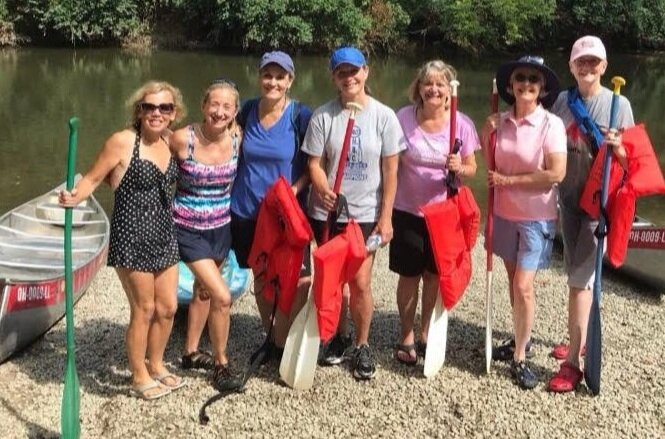
Sliding our canoes into the river, we laughed and commended ourselves for integrating shared experiences into the fabric of our typically structured Growth Group curriculum. The sunny summer day provided a picture-perfect background to our adventurous outing. Soon, though, our opportunity for growth in group dynamics would shove its way into the fiber of our relationships.

Join me on the riverbank where we put in our canoes.

Less experienced canoers paired themselves with those possessing more confidence and expertise, and two-by-two we paddled our way down the scenic, peaceful Little Miami River. The entire waterway belonged to us. Dip, swing. Dip, swing. Dip, swing. Sunlight sparkled off the water, and laughter connected the crafts. No one seemed surprised when the friend manning a kayak shot out in front. As a pacesetter in all aspects of life, her position seemed fitting.

Regarding the rest, one pair, stuck at a fallen tree, later dragged bottom in a shallow spot. Still another twosome shot through rapids with more speed than expected. And, periodically, heads turned to confirm the safety of the duo lagging behind.

But that is not all.

As sights along the river changed, so did the weather, and much too quickly, dark, ominous clouds came rolling in. The menacing claps of thunder overhead shook like kettle drums in a concert hall. And of course, the companion to thunder is lightning. Right?

With the different weather conditions came different opinions on what course of action we should take. Ideas and suggestions filled the heavy humid air. Hmmm…

At the first sandbar, our troupe paddled to shore, dragged the canoes—the aluminum canoes—to the bank, and launched into a decision-making discussion:

  • Should we take our chances and keep going?

  • Should we wait out the storm on the bank?

  • Should we phone for the canoe company to come a get us?

The brainstorming added its own electricity to the environment.

With my agrarian background—whether on a golf course, in a rice field, or on a riverbank—the weather demands respect. My family knows firsthand what it feels like to lose a friend struck by lightning. So for me, the matter seemed abundantly clear.

We should stay out of the water, out of the aluminum canoes, and wait for the turbulent weather to move through, regardless of how long that would take.

However, others in the group felt differently. One person deemed our situation completely safe; lightning never posed a threat in her past. A different individual urged us to press on, regardless; time-sensitive commitments pressed in on her schedule. Another, the information gatherer, made futile attempts to get radar updates on her cell phone. Surely our answer could be found in reliable data! And then, the group’s peace-loving member verbalized a complete willingness to yield to the majority decision, whatever that decision might be.

The drama intensified with each clap of thunder.

Here we were, a group of adventurous, well-trained, God-loving, strong, opinionated women, marooned on the side of a river, hovering under a cloud of inclement weather, expressing polar opposite opinions on how to resolve the dilemma facing us. None of us signed up for a course in group dynamics when we checked in and got our life jackets at the canoe rental. But here we were, students, lo’ even classmates, in the reality of life.

Looking back, one asks, “What did our riverside classroom reveal?”

  1. Each of us brings our life experiences into the dynamics of a group.

  2. These life experiences definitely affect our decision-making grid.

  3. Differences can actually strengthen and equip us in making strategic decisions.

How did this work out?

The ability to move forward with a wise decision came from the mutual respect we valued toward each other. Rather than give way to emotion, tension, and the exertion of self-will, we listened calmly to all perspectives, prayerfully formulated a conclusion, and agreed to move forward collectively, not individually. In the end, based on the radar provided by The Weather Chanel, we eventually climbed back into our canoes, merged into the current, and headed downstream.

Though tentative, I eventually relaxed. But rest assured, a welcomed relief flooded my being when our party rounded the last bend and stowed the paddles.

Yes, even today, our Growth Group shares a knowing chuckle when we hear a rumble of thunder.

Blog.canoeing growthgroup.jpeg

Living With Eternal Intentionality®

What dynamics do you bring to a group when making a challenging decision? When have the differences in perspective led to a sounder, wiser perspective?

“My dear brothers and sisters, take note of this: Everyone should be quick to listen, slow to speak, and slow to become angry” (James 1:19).