
We respect your privacy.

What Does STOP Mean to You?

Blog. What Does Stop Mean to you design (2).png

I have a bad habit that habitually gets me in trouble: I disregard ROAD CLOSED signs. Painful lessons associated with this habit have a way of never dying, perhaps because they are kept alive by new episodes.  

A recent version comes to mind. In fact, each time I drive past a certain intersection, I tremor with embarrassment. I would prefer to just turn my head and look away. The location and I share a secret I now bring myself to confess.

On a particular day, I was in a hurry and had a lot to do. Racing out of my home, I set out on the dark cloudy afternoon with low blood sugar and high expectations. Productivity was my goal, and nothing would deter.

The ROAD CLOSED sign was not part of my plan. So, I thought to myself, "That sign may be there for others, but it is not there for me. I need to use this road, and I need to use it now."

Blog.What Does STOP Mean to YOU?Untitled design (2).png

Well…this self serving attitude launched me down an asphalt version of chaos. Determination kept propelling me forward, and as long as no one was looking, I felt quite fine about “driving” ahead. Covering several miles, I assured myself this was the right decision and it would land me where I needed to be much sooner than if I had taken the well marked detour. After all, detours are for sissies. I quite relished the fact that I actually had the road all to myself.

Until I rounded a curve...and found myself face to face with two imposing versions of the latest in road equipment. Their presence left no option. I had been bested.

Blog.Road Machinery.2IMG_9799.jpg

Forced to turn around, I struggled with a dicey three-point turn—now invoking the help of The Almighty— and barely avoided a nasty looking drop off. In a semblance of humility, I delicately drove back to the point of decision at the intersection, and all the while holding my breath that no one would see me.

Once I was back at the point of error, I dutifully took the detour. Whew. I will never do that again.

Oh really? At least not until the same opportunity came up a brief two weeks later.

Again, I found myself in the same spot, faced with the same decision. I thought, “Surely they don’t mean ROAD CLOSED still. They failed to remove the sign—this is just a good suggestion. I know can get through. After all, this way is much faster that going around. I do not have time for a detour, and I am confident I can poke my way through.

Let me spare you the details and just say, that once again I did not stop, I did not heed the warning, and I barreled right through the ROAD CLOSED sign. And, yes, I once again met the same modern day version of Balaam’s Donkey in the form of menacing pieces of road equipment.

Is STOP only a road sign, or could it possible be a life sign as well? What if we listened to the Holy Spirit and took heed when told not to proceed?

Would conversations be transformed if we obeyed STOP?

Would relationships be preserved if we honored STOP?

Would marriages be saved if we observed STOP?

Would fellowship be preserved if we respected STOP? 

Ah, but we are quick to ignore the ROAD CLOSED signs, and we rush ahead to give our opinions, defend ourselves, and pass judgment.

Why don’t we just  STOP? I am not completely sure, but I am at least attempting to be more respectful of the sign when I see it.

Living With Eternal Intentionality

When is the last time,  in a conversation, that you should have stopped and did not? In a decision?

What Did You Say?

Blog.What Did You Say?.png

That is not what I said.

How often do you find yourself being served the words, “That is not what I said”?

Placing my iPhone on the kitchen counter, I chuckled. It just happened again! "That is not what I said."

Our delicate art of communication requires skill. Focus, concentration, and effort, along with expertise, ingenuity, and imagination need to coalesce like brush strokes on a canvas in the exchange of information. Three recent situations remind me of this reality.

Here they are:

In giving the details of my scheduled hand surgery, a family member groaned upon hearing a description of the anticipated 23 stitches and the repercussions for my busy life. (What I said was 2 to 3 stitches, with quite a different recovery story!)

In hearing of our friends’ European travels, I smiled and envisioned their sublime pleasure moving serenely down the Danube on a Viking Cruise ship. (What I said was biking trip—not Viking trip—in Europe.)

My colleague took his elderly father to be fitted for a hearing aid and learned, to his shock, that he, too, needed to address his hearing issues. (What I said was, “You both need hearing devices.”)

Thankfully, these situations were benign, and each contained a thread of humor. But not all life grants tolerance. You and I have opportunity to bring clarity to the canvas of communication when we mindfully apply a few intentional guidelines:

Guideline #1

Listen not only to what is said, but learn to look for what is meant. You are hearing words which only represent the tip of the iceberg. What actually is beneath the surface and is promoting the expression of content?

Guideline #2  

Pay attention to tone and body language.“That’s ok with me,” might not really be ok.

Guideline #3

Pray silently while you listen; this is one situation in life where multitasking proves profitable. 

Guideline #4

Mentally place yourself in the other person’s position and ask the Holy Spirit to give you supernatural insight in communication.

Guideline #5

Hurry harms good communication. Today’s life pace fights against clear communication. (Do you agree?) Since we often find ourselves tossing words on the fly, let us at least be cognizant of the fact that haste is not helpful.

Guideline #6

Listen to learn, yes, but most of all…listen to love.


Living With Eternal Intentionality

“Everyone should be quick to listen, slow to speak and slow to become angry (James 1:19b)”

What recent communication snafu reminds you of your need to become a better listener?

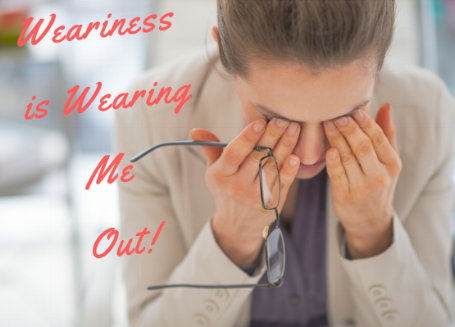
Weariness Is Wearing Me Out!

Blog.Weariness is WearingMe Out!.png

Weariness nears epidemic status in today’s world. Everywhere I go I meet people who are running on empty. Rarely do I meet an individual who says, “Wow! I feel great!”

I am certainly no icon of physical fitness or robust health, but I have learned that life is best lived rested. Too much, too long, too hard are generally signs that we need to recalibrate. Though weariness cannot be avoided—that would constitute a wrong goal—all weariness does not fit into the same category.

Let me explain.

Healthy Reasons for Weariness:

Seeing a challenging job completed with excellence

Staying up several nights in a row night with a teething baby

Investing in the tumultuous life of a teen

Helping a grade school child follow through with a complicated assignment

Concluding a community, church or ministry project

Extending hospitality for a lengthy season to guests in one’s home

Unhealthy Reasons for Weariness:

Saying ‘yes’ when I should say ‘no’

Habitually watching a device too long in the evening

Chatting glibly on social media

Reading a book or magazine past bedtime

Agreeing to guilt commitments that drain the lifeblood from my valid commitments

Neglecting physical exercise

Living with unresolved conflict with one’s spouse

Making a mental diet of a problematic situation or relationship

Three simple suggestions one can implement today which have potential to turn weariness around:

Spend time with Jesus:

“Come to Me all you who are weary and burdened, and I will give you rest” (Matthew 11:28). This sounds like a spiritual spa experience, but too often we overlook the supernatural power of consistently spending time alone in His Presence. To stand under the waterfall of His grace works wonders even when nothing else in life changes.

Spend time outside:

Fresh air is a gift to our psyche and it is nearby, uncomplicated, and economical. Don't overthink this; just spend time outdoors for refreshment.

Spend time under the covers:

A good night’s sleep is always at the top of the list. Go to bed earlier than usual for several nights in a row, and tell weariness to take a hike.

 Living With Eternal Intentionality

Where in your life are your experiencing a healthy reason for weariness?

Likewise, where in your life do you discern an unhealthy reason for weariness?

What one step forward is needed for both situations?

Jesus says, “I have come that you might have life and that you might have it more abundantly, that it might be full and meaningful” (John 10:10). How does this take weariness into account?